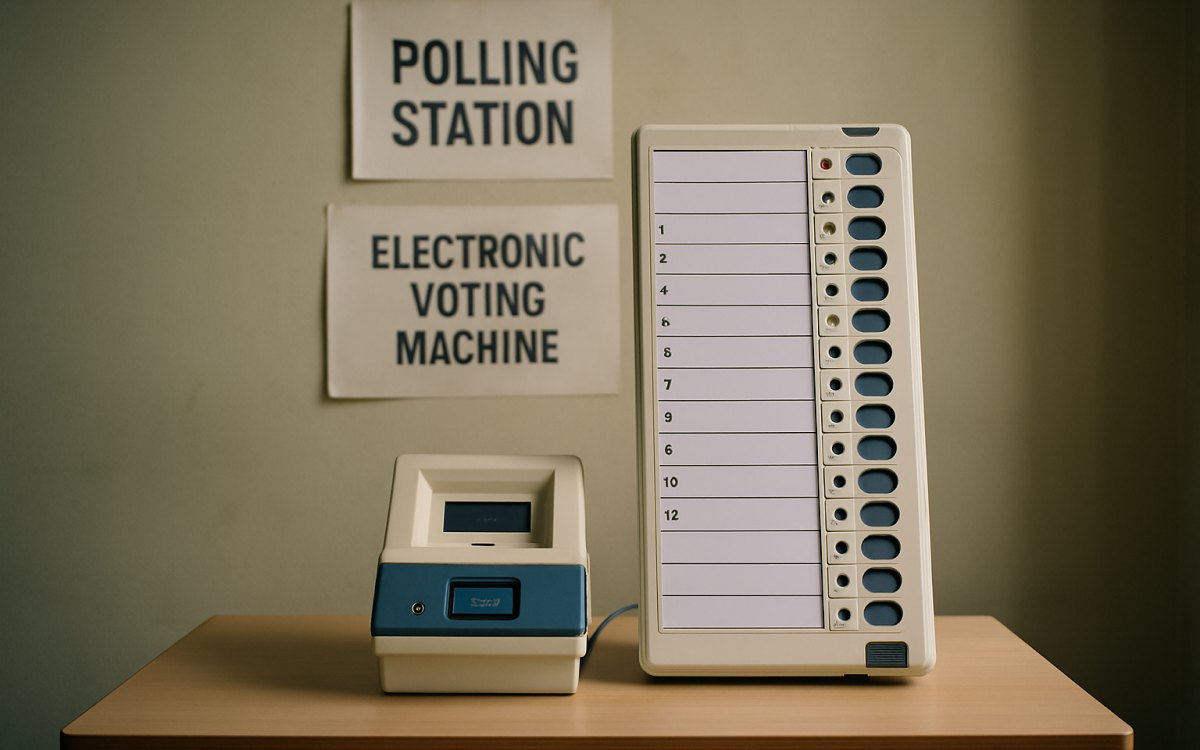
When you step into the polling booth, ready to cast your vote, Electronic Voting Machines, or EVMs, help you by making this process quick and straightforward. These devices have transformed elections by replacing paper ballots with secure electronic recording. This post explains how EVMs function, step by step, so you understand the technology behind your vote.
EVM Components
EVMs consist of two main units: the Control Unit and the Balloting Unit. These units are connected with a five-metre cable before polling begins. The Control Unit remains with the presiding officer outside the voting compartment, while the Balloting Unit is brought inside for use.
The Control Unit features buttons and a display. Presiding officers use it to start polling, check readiness, and stop voting at the end of the day. It records all votes and shows totals when a polling agent requests a count. A small LED screen provides status updates, such as “Polling in Progress” or “Vote Saved”.
The Balloting Unit holds the candidate details. A screen shows names and party symbols next to blue buttons. Each unit supports up to 16 candidates, where the additional units for larger contests can be linked. Braille markings on buttons help visually impaired voters independently identify options.
Both units run on a 7.5-volt alkaline battery from Bharat Electronics Limited or Electronics Corporation of India Limited. This battery lasts through polling without needing mains power or external recharging. There are no plugs or wires connected to the internet or networks; EVMs operate as standalone devices.
Preparation Before Polling
Election officials prepare EVMs well in advance. Manufacturers programme a one-time programmable microchip during production. This chip stores candidate data and cannot accept rewrites or external modifications later.
You witness the first key step at a commissioning centre. Representatives from contesting parties attend as officials switch on the machine. The display shows a unique 14-digit ID number and 0 total votes, and a mock poll follows. The candidate buttons are pressed 50 or more times to test the recording, then the demonstration votes are cleared.
Officials seal both units with pink paper strips and address tags. The party agent then seals and signs. Locks secure the units, and a green paper seal covers the “Result” button on the Control Unit. Authorities store sealed EVMs in strong rooms under CCTV surveillance until polling day.
On polling morning, the seals are verified to check whether they are intact. Presiding officers conduct another mock poll with party agents present. This confirms that there are no votes before voters arrive. Only then does polling begin.
Casting Your Vote
You approach the polling station with your voter ID. After verification, the first voter demonstrates publicly: press a candidate button, hear a beep, and see a light flash next to the symbol. This shows how the machine works.
Inside the compartment, you face the Balloting Unit. Symbols guide your choice clearly, even if you cannot read names. Press the blue button for your preferred candidate. A red LED lights up beside the symbol, and the machine beeps once to confirm your vote.
The beep prevents accidental double presses. If you press another button within five seconds, the machine ignores it and sticks to the first choice. After seven seconds, the unit locks; you must alert the officer to unlock it for the next voter. Your vote transfers instantly to the Control Unit via the cable.
Each EVM records up to 2,000 votes per Balloting Unit. Machines halt after five consecutive incorrect entries or if tampered with, entering a “safety mode” that requires a factory reset.
Voter-Verifiable Paper Audit Trail (VVPAT)
Modern EVMs pair with VVPAT units for added verification. You attach this box below the Balloting Unit. When you press a candidate button, VVPAT prints a paper slip inside.
The slip displays your chosen candidate’s name and symbol. A glass window lets you view it for seven seconds. You confirm the match before the slip drops into a locked container. This trail provides a physical record without compromising secrecy, as no one else sees your slip.
VVPAT uses thermal printing on secure paper. It generates up to 1,000 slips per unit. At the end of polling, officials seal the VVPAT box. Random checks match VVPAT counts with EVM totals for accuracy.
Authorities introduced VVPAT in 2013 and mandated it nationwide by 2019. You benefit from this layer, which allows audits if disputes arise, though routine verification covers one machine per constituency.
Security Features
EVMs prioritise tamper resistance. The microcontroller chip comes masked and one-time programmable. You cannot reprogramme it post-manufacture without visible damage.
Opening the units triggers a switch. If anyone lifts the cover during polling, the machine enters “abnormal mode” and stops accepting votes. A real-time clock logs every event with timestamps, creating an audit trail of presses and actions.
No wireless components exist; votes stay local via cable. Post-polling, officials use a special cartridge to transfer data, but only authorised personnel handle this under supervision. Blank cartridges prevent preloading votes.
Self-diagnostic tests run at power-on. The machine checks memory, buttons, and displays. If faults occur, an error code appears, and officials replace it immediately.
Counting Votes
After polls close, party agents gather for pre-count checks. Officers unseal the Control Unit, conduct a mock poll again to verify zero votes, and break seals.
Press “Result” to display totals. The LED screen cycles through candidates, showing vote counts one at a time. The figures are noted on Form 17C. This “paper total” matches electronic results before deeper counts.
For full counting, officials insert a memory cartridge. Data transfers to a laptop running ECI software. Totals print and post at the table. VVPAT slips are counted manually for selected machines, cross-verifying the electronics.
Authorities store EVMs and VVPATs for 45 days after the declaration. You request recounts within this window if the margins fall below 2%. M3 EVMs, introduced recently, enhance speed and security with faster processors.
Maintenance and Upgrades
ECI maintains EVMs through rigorous checks. Factories calibrate units yearly. Field teams clean and test machines before each election cycle.
Upgrades like M3 models handle larger voter turnouts and resist environmental factors like heat and dust. Batteries now last longer, and displays improve visibility.
Training covers all handlers. Presiding officers practice on simulators. Manufacturers provide 24-hour helplines for issues. Post-election, EVMs undergo random sampling to ensure integrity.
Advantages for Voters
EVMs speed up your experience. You vote in seconds, reducing queues. No paper means no invalid votes from folds or marks.
Battery power works in remote areas. Symbols aid illiterate voters. VVPAT gives you confidence in verification.
Counting finishes overnight, unlike days for paper. Results reach you faster, enabling swift government formation.
Common Queries
- Do EVMs need electricity?
No, batteries suffice for a full day.
- Can you hack them?
A standalone design and the absence of networks prevent remote access. Physical tampering shows visibly.
- What if a button fails?
Officers replace the unit on-site from reserves.
- How long do records last?
EVM memory retains data for 10 years; VVPAT paper for audits.
EVMs continue evolving. You rely on them for efficient, verifiable voting. Next time you vote, recall these steps for greater appreciation.